There are four species within this group of sloths. Occasionally it will be said that there are only three species of Three-Toed Sloths, the reason for this is that the fourth species is newly discovered, found in the last 11 years (Guarino, 2009). All four species are part of the same genus, which means that the Kingdom, Phyllum, Class, Order, and Family are also the same. The common names for these four species are: Pygmy Three-Toed Sloth, Maned Three-Toed Sloth, Pale-Throated Three-Toed Sloth, and Brown-Throated Three-Toed Sloth.
As indicated by its name, the three-toed sloth has claws on three of its toes on each limb. Depending on the species the color patterns of these sloths change, but the differences are not always noticeable enough to be able to distinguish between species after a quick glance. The three-toed sloth is most commonly found in South America (Steele, 2002). On average the three-toed sloth is smaller and moves less than the two-toed sloth (Steele, 2002). It is rare to have three-toed sloths in captivity because they have a very small, specific, diet (Bullinger, 2009).
  | Pygmy Three-Toed Sloth The Pygmy Three-Toed Sloth is the smallest known sloth alive. In addition to being small, the area it inhabits is very small too, no more than two square miles (Guarino, 2009). It is believed that this species of sloth is so much smaller than others due to its isolation from all other populations, which resulted in a divergent evolution; it is believed that the small island, Isla Escudo de Veraguas, separated from the main land of Panama about 8900 years ago (Yarbrough, 2010). There is not a large amount of information available on this species of sloth because it is a rather new discovery. It was not found until approximately 2001 - only 11years ago (Guarino, 2009). Details about its physical description have been gathered, however. On average these small creatures are about 19.9 inches and 6.3 pounds, as adults (Guarino, 2009). To put this in perspective, these sloths are about the size of a human baby at birth. Within this species there are noticeable physical differences between males and females, mostly related to color pattern (Guarino, 2009). Since there is still not much information about these sloths, some details about other species are attributed to the Pygmy Three-Toed Sloth as probable characteristics. |
Maned Three-Toed Sloth The Maned Three-Toed Sloth can be found in patches on the coast of Brazil (Bullinger, 2009). Because they live only in Brazil, they have also been called "Brazilian Sloths" ("Maned Three-Toed Sloth"). When looking at pictures of Maned Three-Toed Sloths, they do not look like small very creatures. In actuality, however, these sloths are only about 17.5-19.5 inches long and only weigh about 8-9 pounds(Bullinger, 2009). As indicated by the name, it seems as if the sloth has a mane around its head, produced by a darker and slightly longer type of fur (Bullinger, 2009). Unlike other species of three-toed sloths, it is often very hard to distinguish male and female Maned Three-Toed Sloths just by looking at them (Bullinger, 2009). There is evidence, however, that the females are slightly larger than males (Bullinger, 2009). Because sloths are rather solitary animals, it is possible that the differences in size are not easily noticed because the animals are too far apart to accurately compare. Like all other sloths, Maned Three-Toed Sloths give birth to only one offspring at a time. After a six month gestation period, offspring are born with a weight of about 10.5 ounces (Bullinger, 2009). The offspring are independent by about six months of age, and sexually mature, both males and females, around three years ("Maned Three-Toed Sloth"). These sloths are fully grown between one and three years; they are suspected to live 20 years, however this is a guess because the exact lifespan is still unknown. (Bullinger, 2009). In past years, the Maned Three-Toed Sloth has been considered endangered, but as of 2011 its status changed and it is now listed as vulnerable(Bradypus torquatus). This indicates that there is potential for the species to go extinct, but with minimal efforts this species should be able to regain a large enough population that its existence will no longer be in question. One of the major threats to the Maned Three-Toed Sloths was deforestation; thankfully over the past 30 years these practices have been decreasing, though not entirely eliminated (Bradypus torquatus).
|  |
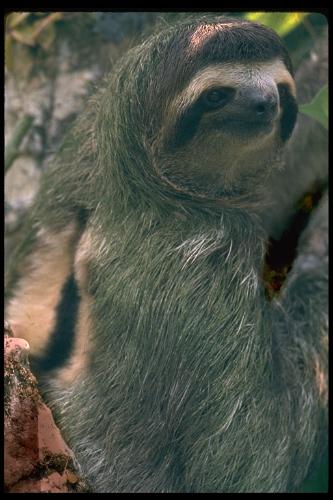 | Pale-Throated Three-Toed Sloth The Pale-Throated Three-Toed Sloth is found mostly in the canopies of the rainforests from Southern Central America to Northern Argentina (Hughes, 1999). Even though these interesting creatures spend so much time upside down in the tree tops, they are still able to turn their heads to see the ground. They can rotate their head about 270 degrees due to extra vertebrae in their necks (Hughes, 1999) These sloths are between one and a half to two and a half feet long and weigh about 5-12 pounds (Hughes, 1999). Although they typically have grayish fur, with a tint of green from algae, males have a bright yellow or orange patch of fur on their back (Hughes, 1999; "Pale-throated three-toed sloth," 2008). The coloring of these sloths help in their protection, but if attacked they can also use their claws and teeth to defend themselves (Hughes, 1999). The fact that they spend so much time sleeping may also help protect them; while sleeping they are still which means they will not be making noise or motions that may attract predators. Approximately 79% of the Pale-Throated Three-Toed Sloth's day is spent sleeping, more or less than 17 hours each day (Hughes, 1999). This is about the same amount of time that many humans spend awake each day (based on a person who gets seven hours of sleep each day). There is no specific breeding period for Pale-Throated Three-Toed Sloths, but at the end of the rainy season there is an increase in the amount of breeding that occurs ("Pale-throated three-toed sloth," 2008). It is rare for male sloths to reach sexual maturity before females, but male Pale-Throated Three-Toed Sloths are sexually mature by about age three while females are not mature until about four and a half years of age (Hughes, 1999). The gestation period for this species of sloths is approximately six months; after birth it only takes about one month for the young sloth to be weaned and become capable of eating solid food, but they typically stay with their mother for about six to nine months after birth ("Pale-throated three-toed sloth," 2008).
|
Brown-Throated Three-Toed Sloth The Brown-Throated Three-Toed Sloth is found in many tropical forests in South America and southern parts of Central America; on occasion they are even found in less tropical locations (Jung, 2011). The average Brown-Throated Three-Toed Sloth weighs 9.5 pounds and is 23.5 inches (Jung, 2011). They get there name from the brown fur that covers the head and throat (Jung, 2011). Males typically have a white or orange patch of fur on their backs with a black stripe running vertically through it, females do not have these markings which makes it easy to diefferentiate between sexes (Chan, 1999). This species of sloth spends 14-16 hours sleeping each day; that is more than half the day (Bradypus Variegatus). They are not very picky about what kind of tree inhabit, but they like to have a decent amount of sunlight because of their low body temperature (Jung, 2011). Brown-Throated Three-Toed Sloths are thought to be monogamous; mating typically occurs in the female's tree (Jung, 2011). After a five to six month gestation period, the female Brown-Throated Three-Toed Sloth gives birth with help from other females (Bradypus Variegatus). The young typically weigh less than two pounds at birth (Jung, 2011). By four months of age the offspring will be weaned, and is expected to become independent; within three years the females will be sexually mature, while the males take three to five years to reach maturity (Bradypus Variegatus). Because the time from conception to offspring independence is typically nine to ten months, females are thought to spend almost half of their life pregnant (Chan, 1999). | 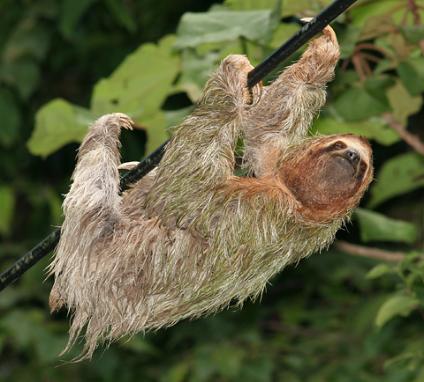 |
