Unlike the three-toed sloth, these sloths are very well adapted to changing environments and are therefore able to thrive in captivity (Myers, 2001). In addition, these sloths are more nocturnal than the three-toed sloths and are more active too (Hoffman's Two-Toed Sloth (a)). While they have two claws on their forelimbs, which is where their name comes from, they have three claws on their hindlimbs, something many people may not know (Meyers, 2001).
 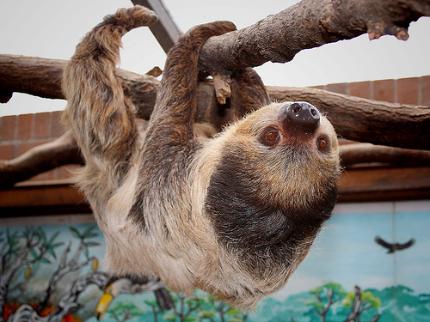 | Southern Two-Toed Sloth The Southern Two-Toed Sloth is found mostly in Central America and in some northern parts of South America (Felton-Church, 2000). They are typically nocturnal and very solitary (Southern Two-Toed Sloth (a)). Just like other sloths, the Southern Two-Toed Sloth spends over half of the day sleeping, 15 hours; however, unlike other sloths, these 15 hours are spent curled up in the forks of trees rather than hanging upside down (Felton-Church, 2000). Similar to its relative the Hoffman's Two-Toed Sloth these creatures are about 8.5-17.5 pounds and 21-29 inches (Felton-Church, 2000). They often have darker colored legs than body and face, which are a tan or brown color (Southern Two-Toed Sloth (b)). These legs, unlike other sloths, are almost all the same size (Felton-Church, 2000). Their teeth are continually growing, but because of the food that they eat their teeth are kept to about the same size (Felton-Church, 2000). Female Southern Two-Toed Sloths are sexually mature by age three, while their male counterparts are not mature until four to five years of age (Felton-Church, 2000). Young are born about 12 ounces after a 5-6 month gestation period (Felton-Church, 2000; Southern Two-Toed Sloth (a)). In comparison to the mothers, these babies are extremely small. For six to nine months the babies cling to their mothers' bellies until they are able to live on their own (Felton-Church, 2000). |
Hoffman's Two-Toed Sloth The Hoffman's Two-Toed Sloth are found in the lowland forests and higher altitude rainforests in South America and occasionally in Central America (Apostolopoulos, 2010). These sloths are typically 10-20 pounds and about 21-29 inches ((Hoffman's Two-Toed Sloth (a)). They have a brownish fur color that can range in shades from light tan to a darker brown (Hoffman's Two-Toed Sloth (b)). Like many other sloths, their fur is tinted green during rainy seasons due to algae (Apostolopoulos, 2010). This plus their natural fur color helps keep them protected from predators. Hoffman's Two-Toed Sloths have between 5 and 8 vertebrae in their neck, resulting in a shorter neck than most. This helps the sloths hold their heads up while they are upside down, even though they have less muscle than would be proportionally expected (Apostolopoulos, 2010). There is no clarified mating season for the Hoffman's Two-Toed Sloth (Hoffman's two-toed sloth (c)). After an 11.5 month gestation period, baby sloths are only about 3/4 of a pound at birth; mothers are then still responsible for their young for 6-9 months after birth (Apostolopoulos, 2010). There is usually a 15 month period of time in between pregnancies (Apostolopoulos, 2010). Females are sexually mature by the time they reach three years of age, and males mature by around age four to five(Hoffman's Two-Toed Sloth (b)). On average Hoffman's Two-Toed Sloths have a life span of about 12 years in nature, but that drastically increases to about 30 years in captivity (Apostolopoulos, 2010). During this time it is very uncommon for sloths to leave the direct area in which they were born; however, they are typically very solitary animals (Apostolopoulos, 2010). | 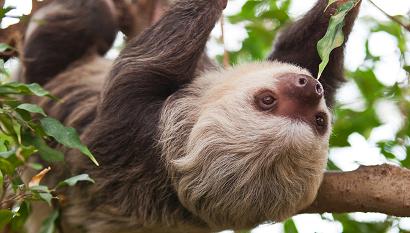 |
